
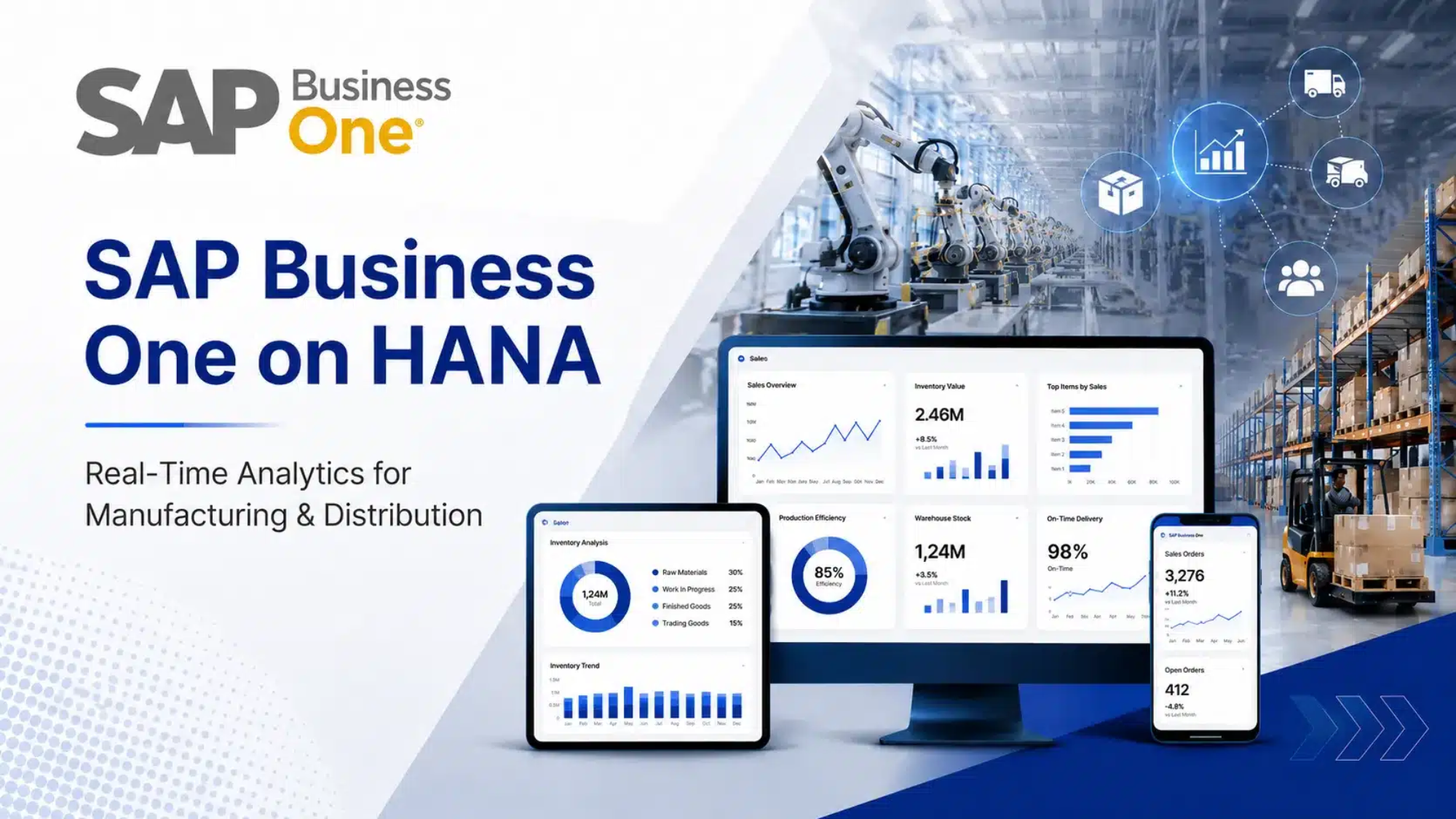
For manufacturers and distributors, the difference between a good quarter and a great one often comes down to one thing: how fast you can turn data into a decision. SAP Business One running on the SAP HANA database is built precisely for that speed — replacing overnight reports and gut-feel inventory calls with real-time answers. Here is what that means in practice.
- What is SAP Business One on HANA?
SAP HANA is an in-memory database, which means it holds and processes data in memory rather than reading it slowly from disk. When SAP Business One runs on HANA, reports and analytics that once took minutes return in seconds — and you can analyse far larger data volumes without the system slowing down. It is the same Business One you know, with a dramatically faster engine underneath and analytics tools built to exploit it.
WHY IT MATTERS FOR OPERATIONS
In manufacturing and distribution, decisions are time-sensitive: stock-outs, over-stocking, and delayed reporting all cost money. Real-time data turns those from end-of-month surprises into in-the-moment adjustments.
- The advantages that matter on the shop floor and in the warehouse
- Real-time analytics & dashboards: See sales, inventory, production, and finances as they happen — not as they were yesterday.
- Smarter inventory forecasting: HANA enables advanced forecasting techniques — including methods like triple exponential smoothing and regression with damped trend and seasonal adjustment — to predict demand and right-size stock.
- Faster, ad-hoc reporting: Build reports with query wizards, Crystal Reports, or Excel-based interactive analysis using pivot tables on live data.
- Scales with data volume: As transaction and SKU counts grow, performance holds up where a traditional database would strain.
- Web & mobile reach: Portals and dashboards extend your B1 data to the web, putting key numbers in front of sales reps, managers, and even customers.
- What this looks like for a distributor
Imagine a distributor carrying thousands of SKUs across multiple warehouses. On a traditional setup, the buyer reorders from last month’s report and intuition — and routinely ends up both over-stocked on slow movers and out of stock on best-sellers. On HANA, demand forecasting runs against live sales velocity and seasonality, reorder suggestions update continuously, and a manager sees true stock position across every location on a single dashboard. The result is less cash tied up in inventory and fewer lost sales.
- What this looks like for a manufacturer
For a manufacturer, real-time visibility connects the dots between sales orders, bills of materials, production schedules, and procurement. When demand shifts, the impact on material requirements and capacity is visible immediately rather than discovered at month-end. Combined with industry-specific templates for sectors like foundry and forging, pharma, automotive components, or FMCG, the system reflects how the business actually runs — which is what turns software into results.
THE HANA DECISION IN CONTEXT
Moving to HANA is a meaningful step, and it is not automatically right for every business. The deciding factors are your data volume, reporting needs, and appetite for real-time analytics. An experienced partner will tell you honestly whether the SQL version is sufficient or whether HANA will pay for itself.
- Is HANA right for your business?
As a guide, the value of HANA rises with the size of your data and the speed at which you need to act on it. High-volume distributors, multi-warehouse operations, and manufacturers with complex planning tend to benefit most. Smaller, simpler operations may be perfectly well served by the SQL version today and can move later. The point is to match the platform to the need — exactly the kind of assessment a focused SAP Partner performs before recommending anything.
Frequently asked questions
Is SAP Business One on HANA the same as S/4HANA?
No. SAP Business One on HANA is the SME product running on the HANA database. SAP S/4HANA is a separate, enterprise-tier ERP that runs natively on HANA. Article 3 compares the two in detail.
Do I need to be a manufacturer to benefit from HANA?
Not at all — any data-intensive business gains from real-time analytics. It is simply especially impactful in manufacturing and distribution, where inventory and production decisions are constant and time-sensitive.
Can I move to HANA later if I start on SQL?
Yes. Many businesses begin on the SQL version and migrate to HANA as data volumes and analytics needs grow. A good partner plans for that path so the move is smooth when the time comes.
CALL TO ACTION
Run a manufacturing or distribution business? See what SAP Business One on HANA could do with your data. Book a tailored demo with Inecom and we’ll show real-time forecasting and dashboards built for your industry.